The Scale of Invisibility
We tend to measure humanitarian catastrophes by their visibility in Western media cycles, which means Sudan’s ongoing war has become something like the forgotten war of the forgotten war. By early 2026, the UN Office for the Coordination of Humanitarian Affairs documented that internal displacement in Sudan had exceeded 11 million people, a figure that now surpasses the displacement crisis in Ukraine and represents the largest internal displacement emergency on Earth. Yet where are the nightly news segments? Where are the coordinated fundraising campaigns that mobilized billions for other emergencies? The answer reveals something uncomfortable about how geopolitical attention operates: visibility correlates less with suffering than with perceived relevance to Western security interests.
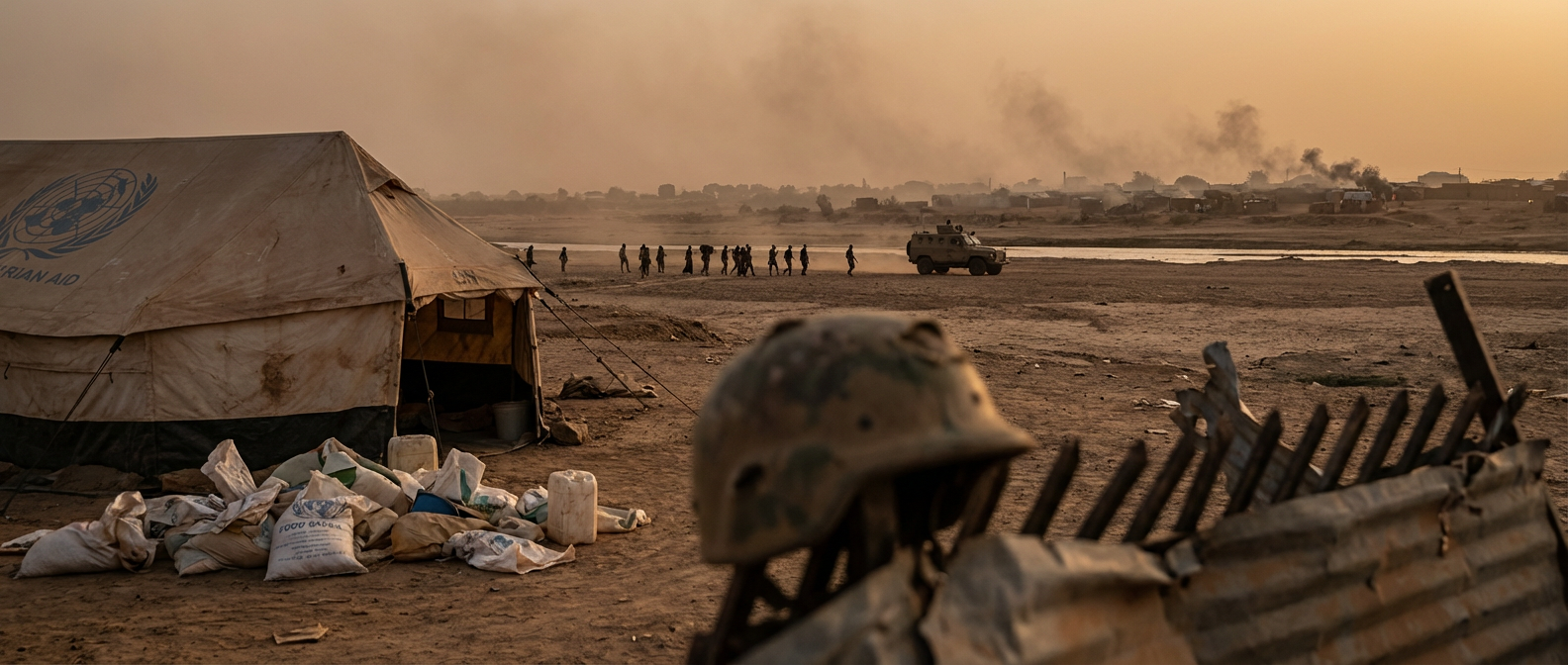
The famine metrics tell an even starker story. As of December 2025, the UN World Food Programme classified approximately 8.1 million Sudanese people as facing emergency or catastrophic famine conditions. That number exceeds the total population of most countries. We are watching a humanitarian emergency of truly staggering proportions unfold in real time, yet it remains largely absent from international policy conversations that command serious resources and diplomatic energy. This is not accidental oversight. It reflects deliberate choices about which crises warrant sustained attention.

The Regional Powers and Their Unspoken Competition
Understanding why Sudan has faded from global consciousness requires understanding the conflict itself, which is not simply a civil war in the traditional sense but a proxy struggle between regional powers using state collapse as their arena. The Rapid Support Forces, the paramilitary faction battling Sudan’s official military, have received documented weapons and logistical support from the United Arab Emirates according to a December 2025 UN Panel of Experts report submitted to the Security Council. This matters not because outside military support to warring factions is unusual, it isn’t, but because it reflects a calculated regional strategy where the UAE sees advantage in supporting forces that challenge the Sudanese central government.
This proxy dimension extends to the Security Council itself, where Sudan’s fate has become hostage to great power rivalry. Russia blocked three separate UN Security Council resolutions on Sudan between January 2025 and January 2026, wielding its veto unilaterally or alongside China in two of those instances. The stated Russian objections varied, but the pattern is clear: Russia continues to view any UN action that might constrain military actors or create international accountability as an infringement on state sovereignty. This doctrine, which Moscow deploys selectively depending on whether it favors the incumbent government or challengers, effectively paralyzes multilateral mechanisms precisely when they are most needed.
Historical Parallels and Their Limits
Observers occasionally draw comparisons between Sudan’s current conflict and the Yugoslav wars of the 1990s, and the comparison illuminates something important even as it ultimately breaks down. In both cases, we see the collapse of a state structure, regional powers seeing opportunity in that collapse, and international institutions struggling to respond with sufficient coherence. The humanitarian toll in Yugoslavia, particularly during the Bosnian war, reached devastating levels before international intervention eventually occurred. The comparison makes observers wonder whether Sudan might similarly demand intervention before the world really pays attention.
But here the analogy weakens in revealing ways. Yugoslavia’s wars occurred in Europe, with immediate spillover implications for NATO members and European security architecture. Sudan, by contrast, sits in Africa’s strategic periphery from the perspective of Western capitals. The international legal mechanisms that emerged from Yugoslavia, the International Criminal Court prominent among them, now function in an environment far more hostile to accountability than the 1990s. The ICC issued two new arrest warrants for RSF commanders in November 2025 related to mass atrocity crimes in Darfur, bringing the total number of active Sudan-related warrants to seven. Yet these warrants carry minimal enforcement weight when the Security Council is deadlocked and the regional powers directly invested in the conflict face no pressure to comply.
The Humanitarian Catastrophe as Political Structure
What makes Sudan particularly difficult to address is that the humanitarian emergency is not separable from the political conflict itself. This distinguishes it from some other crises where humanitarian access can theoretically proceed independent of political settlement. In Sudan, the famine and displacement are not unfortunate byproducts of conflict but part of the strategic logic. When you examine how the fighting has unfolded, you see patterns consistent with deliberate obstruction of food supplies and targeted displacement of civilian populations. Addressing the humanitarian emergency therefore requires simultaneously addressing the underlying conflict, a task that requires Security Council consensus that simply does not exist.
The UN OCHA Sudan Humanitarian Response Plan 2026 outlines the scale of need, but the document reads more as a wish list than an operational blueprint. The World Food Programme Sudan Emergency Situation Report details the emergency while acknowledging chronic funding shortfalls and access constraints that make even basic food distribution episodic rather than systematic. These organizations understand the problem with remarkable clarity. What they lack is the political environment necessary to implement solutions at the required scale.
Why This Matters Beyond Sentiment
Sudan’s invisibility in international politics carries consequences that extend well beyond humanitarian accounting. Allowing a conflict of this magnitude to proceed without meaningful multilateral intervention, while the Security Council remains captured by great power rivalry, demonstrates something bleak about the current international system. It suggests that humanitarian crises warrant attention largely insofar as they serve the interests of powerful states. When they don’t, when they occur in regions without immediate geopolitical salience to those states, the international community defaults to inadequate funding for NGOs and quietly accepts catastrophic loss of life.
There’s also the question of precedent. If Russia and China can consistently block action on a crisis of this magnitude without facing diplomatic costs, what does that establish for how the Security Council functions elsewhere? The answer appears evident in the patterns we observe across multiple conflicts where great power rivalry has rendered multilateral institutions inoperative.
Sudan’s war has now entered its third year with no clear path toward resolution, a humanitarian emergency that has displaced more people than any other crisis on Earth, and a geopolitical deadlock that prevents serious international response. Whether this changes depends on whether external powers perceive sufficient interest to overcome their current incentives toward stalemate. Until that calculation shifts, Sudan will likely remain what it has become: a massive humanitarian emergency that the world has somehow learned to overlook. What would change your mind about the seriousness of this crisis? What specific interventions do you think the international community should pursue despite these structural obstacles?
