The Headline Versus the Scorecard
When the Department of Government Efficiency released its preliminary findings in spring 2025, the numbers seemed almost startling in their ambition. Over $150 billion in potential federal spending cuts, the department claimed, sitting there for the taking if only the bureaucratic machinery could be sufficiently streamlined. The figure dominated cable news cycles and appeared in countless op-eds as either vindication or catastrophe, depending on one’s political orientation. Yet six months into this experiment, a more complicated picture has emerged, one that resists the neat narrative of either triumphant efficiency or wasteful destruction.

The Congressional Budget Office, the legislative branch’s independent fiscal arbiter, conducted its own rigorous analysis of the cuts that actually materialized. What they found was a significant gap between ambition and reality. Approximately $27 billion in verified savings had been realized by mid-year, according to their methodology. That’s not nothing. It represents real money, real reductions in planned expenditures. But it also represents about eighteen percent of the administration’s headline claim. Understanding why this gap exists means moving beyond the political theatre and into the actual mechanics of how federal spending works.
Why Cutting Government Is Harder Than It Sounds
Here’s where the discussion gets genuinely complicated, and we should sit with that complexity rather than retreat into partisan certainty. Federal spending is not a simple ledger where you cross out line items and redirect money. Most federal spending is statutorily mandated. Social Security checks flow because Congress passed a law establishing Social Security. Medicare exists because of legislation. Veterans benefits, federal employee pensions, highway maintenance across state systems—these are not discretionary line items that an executive branch department can eliminate through enthusiastic management.
A Brookings Institution analysis published this past August examined the specific agencies DOGE targeted most aggressively and made a stark finding: roughly sixty percent of those agencies operated under statutory mandates that made the proposed reductions legally questionable or outright prohibited. This matters enormously for understanding what’s actually happening. When the Office of Personnel Management reported that federal civilian employment fell by approximately 75,000 positions during the first six months through a combination of buyouts, reductions in force, and resignations, that number tells us something real about staffing levels. But it doesn’t tell us whether services were reduced, eliminated, or simply performed less efficiently.
The Legal Resistance and What It Reveals
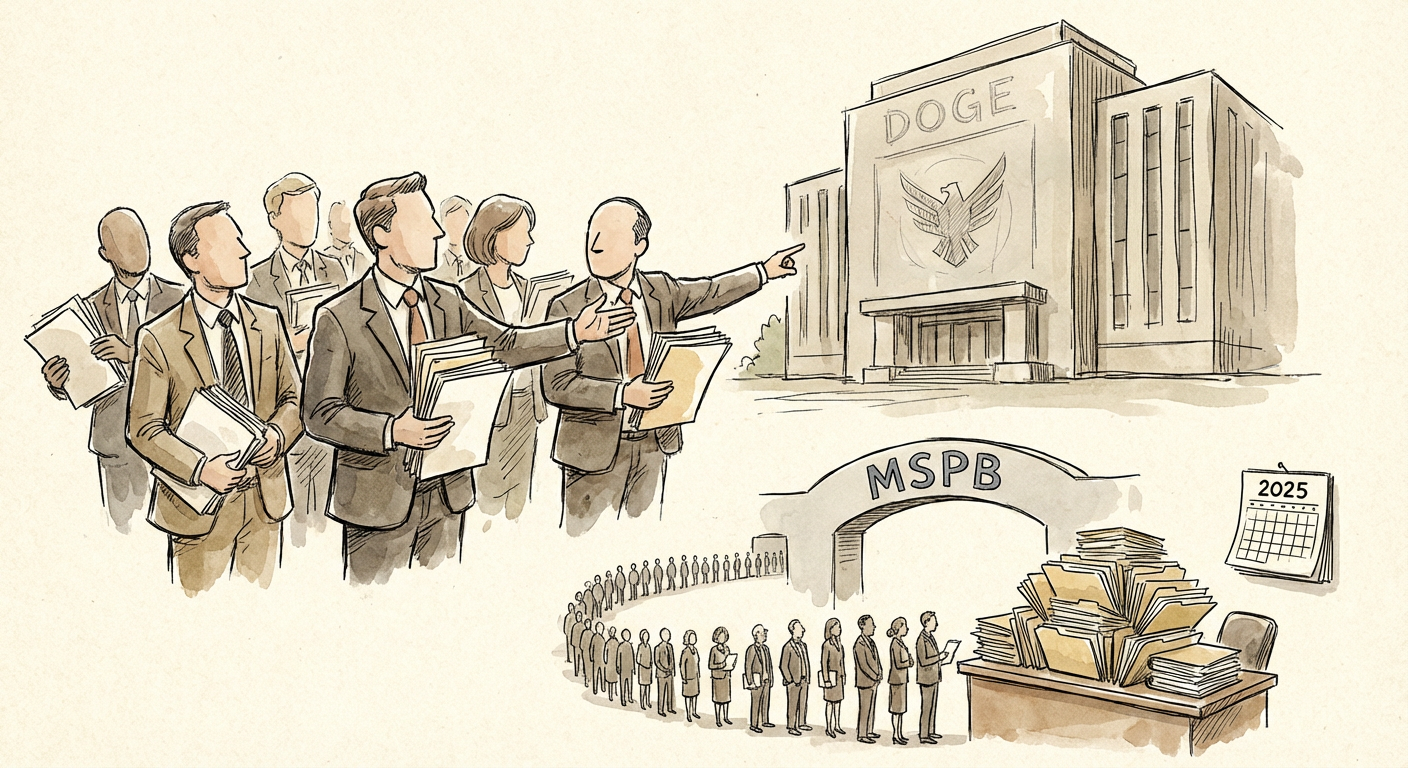
By mid-year, federal employee unions had filed over 200 legal challenges against various DOGE-related directives. These weren’t frivolous suits filed by obstinate bureaucrats. Many raised genuine legal questions about whether the administration had authority to implement the proposed changes. The Merit Systems Protection Board, which adjudicates federal employee grievances, found itself managing a backlog of approximately 40,000 pending cases by the end of the year. That backlog is itself a data point worth examining.
The proliferation of litigation reflects something important about American administrative law: it’s not infinitely flexible. There are constraints built into how executive power actually functions, constraints that don’t disappear simply because an administration arrives with a mandate for efficiency. Some of these constraints exist for good reasons, protecting career civil servants from purely political firing, for instance, or ensuring that statutory mandates get fulfilled. Others may be outdated or counterproductive. But they exist, and they matter to how change actually happens versus how it gets announced.
Reading the Real Numbers
So what do we actually know? The Congressional Budget Office: Analysis of Executive Branch Spending Reduction Actions provides the most credible starting point. Their $27 billion figure represents cuts they could verify through standard budgetary analysis. The administration’s $150 billion figure includes projected savings from proposed restructurings, eliminated programs that haven’t yet gone through legal challenge, and efficiency gains that assume successful implementation of measures still in litigation. Neither figure is false exactly, but they measure different things. One measures what’s happened. The other measures what might happen if legal challenges fail and implementation proceeds smoothly.
The 75,000 position reduction is real. Those people left federal employment. Whether that represents a net improvement in government efficiency or a degradation of service capacity depends almost entirely on which agencies experienced the cuts and what functions they performed. A reduction in administrative overhead at a large bureaucracy might genuinely improve efficiency. A reduction in inspection capacity at a regulatory agency might reduce oversight without reducing cost. The data alone doesn’t tell us which we’re looking at.
The Verdict So Far: Incomplete and Contested
What becomes clear when you examine this six-month report card is that DOGE represents a genuine attempt to reshape how the federal government operates, but one constrained by law, litigation, and the sheer complexity of how government actually functions. The administration has achieved real reductions in federal employment and verified savings in the tens of billions. That’s not trivial. But it’s also substantially less than the initial promises suggested, and much of it remains either contested in court or dependent on maintaining these staffing levels while services continue to be delivered.
The Brookings Institution: Evaluating DOGE’s Legal and Fiscal Foundations analysis suggests that further cuts face steeper legal barriers than those already achieved. That’s worth taking seriously. It suggests we’re past the low-hanging fruit of redundancy and administrative excess, if we were ever really dealing with much of that to begin with. The real question going forward isn’t whether government can be made more efficient—it probably can be—but whether this particular approach can navigate the legal and statutory obstacles that have already begun to accumulate.
So where does this leave us? DOGE is real, its impacts are measurable, and its limitations are becoming increasingly evident. Whether you view those limitations as prudent constitutional constraints or bureaucratic obstruction depends partly on your political commitments. But both interpretations can draw on genuine evidence from these first six months. What seems increasingly unlikely is that the final accounting will match either the most enthusiastic projections or the most apocalyptic warnings. We’re looking at something more modest and more complicated than either camp initially suggested—which is perhaps the most honest thing we can say about a government reform effort at this stage.
