The Trillion-Dollar Question: How Promises Meet Reality
When the Department of Government Efficiency launched via executive order in January 2025, it came with an audacious promise: cut $2 trillion from federal spending over eighteen months. To put that figure in context, it represented roughly five percent of total anticipated federal spending over that period. The announcement attracted enormous media attention, partly because Elon Musk’s involvement gave the initiative celebrity cachet, but mostly because the scale of the proposed cuts seemed simultaneously impressive and vaguely implausible to anyone who understood federal budget mechanics. What followed wasn’t a conspiracy or a secret plot. It was something more instructive: the collision between techno-optimism and institutional complexity.

The appeal of the DOGE framing was understandable. Federal budgets are genuinely difficult to parse. Redundancies do exist. Procurement processes at large agencies can be inefficient. The proposition that government could identify trillions in waste without touching core programs like Social Security or Medicare resonated with voters skeptical of Washington’s competence. But here’s where the political economy gets interesting: identifying waste and actually eliminating it operate under completely different logics. The first requires spreadsheet analysis. The second requires navigating law, institutional resistance, congressional appropriations processes, and the uncomfortable fact that someone’s inefficiency is usually someone else’s job or economic lifeline.
This tension between the theoretical and the actual became the defining feature of DOGE’s first year. By late 2025, the office had revised its savings claims downward multiple times. Independent analysts at the Congressional Budget Office began publishing critiques of DOGE’s methodology, suggesting that reported cuts conflated proposed reductions with actual spending changes, and that some claimed savings involved moving expenses between budget categories rather than eliminating them entirely. That distinction matters enormously when you’re trying to assess whether the office actually did what it said it would do.
The Foreign Aid Pause: Swift Action, Deferred Consequences
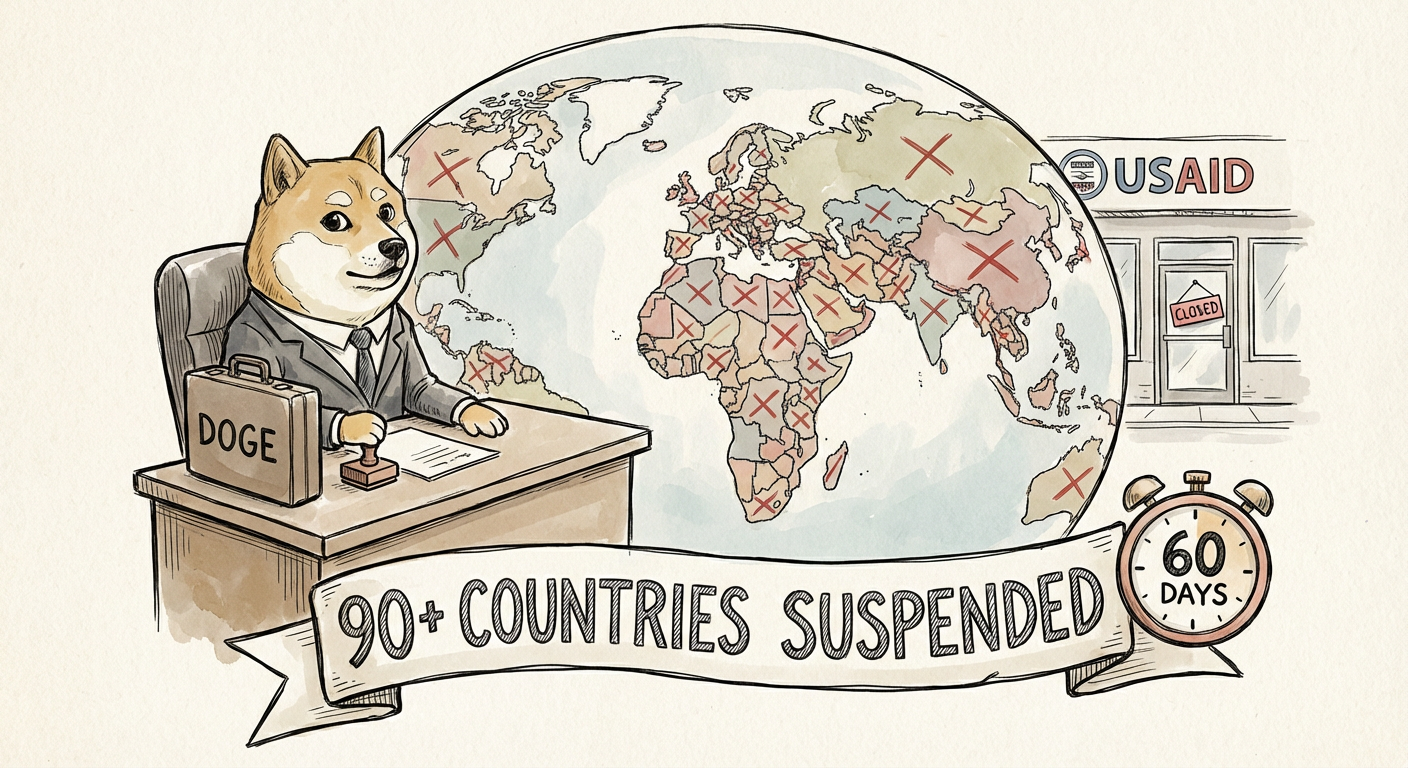
If there was one area where DOGE demonstrated real speed, it was international assistance. Within sixty days of beginning operations, the office had suspended foreign aid programs across more than ninety countries. The rationale was straightforward: why send development assistance abroad while the domestic budget faced constraints? From a certain accounting perspective, the logic held. From a foreign policy perspective, things became substantially messier.
What made this case study valuable wasn’t the ideological debate about foreign aid’s merits. It was what it revealed about how budget cuts work in practice. When programs got suspended, real people experienced real disruptions. Health initiatives paused. Development contracts halted. In some cases, humanitarian organizations had to recalibrate operations mid-year. Politically, this created a peculiar dynamic: DOGE could claim significant dollar reductions almost immediately, yet those reductions existed primarily on paper until the fiscal year ended and actual spending patterns reflected the changes. The office had moved quickly because its authority in this arena, while contested, was relatively clear. But that clarity existed partly because foreign aid lacks the domestic constituency and legal protections that other budget categories have.
This asymmetry points to a deeper structural reality about budget cuts: they move fastest in areas with the least political infrastructure defending them. Medicare beneficiaries have AARP and decades of political mobilization behind them. Federal employees have unions and statutory protections. Foreign aid recipients, scattered across dozens of countries, have no unified domestic advocacy. DOGE’s most visible early wins came from areas where resistance was structurally weakest, not necessarily where waste was most concentrated.
The Legal Gauntlet: When Efficiency Meets Statutory Authority
If foreign aid cuts moved smoothly, workforce reductions hit immediate friction. Multiple federal employee unions filed lawsuits challenging DOGE’s authority to implement certain personnel reductions, arguing that civil service law required specific procedures before firing federal workers. By mid-2025, at least three federal district courts had issued temporary restraining orders against specific workforce reductions, effectively blocking DOGE from executing portions of its planned cuts.
This legal resistance wasn’t reflexive bureaucratic obstruction. It rested on statutes passed decades ago to prevent exactly what the unions argued was happening: circumventing merit system protections through executive fiat. Office of Personnel Management data showed that the federal government employed roughly 2.1 million civilians. Even modest percentage reductions would affect hundreds of thousands of people. Each reduction presumably triggered procedural requirements: notification periods, documentation of performance issues, opportunity for appeal. These weren’t bureaucratic luxuries invented to frustrate efficiency. They were legal guardrails meant to ensure workforce reductions didn’t become arbitrary or politically motivated.
What emerged from these legal battles was a clear principle: executive branch efficiency initiatives operate within a thicket of statutory constraints that don’t disappear simply because an executive order declares them secondary to efficiency goals. The courts weren’t saying DOGE had no authority to reduce the workforce. They were saying that authority existed within legal frameworks that couldn’t simply be overridden. This revealed something real about the efficiency promise itself. Speed and legal process don’t harmonize neatly, and pretending otherwise doesn’t make the statutes go away.
The Leadership Question: When Private Incentives Meet Public Duties
In May 2025, roughly four months into his formal DOGE leadership role, Elon Musk stepped back from day-to-day involvement. The official rationale was straightforward: demands from his private companies required his attention. On its surface, that seemed reasonable. Nobody expected Musk to abandon Tesla and SpaceX indefinitely. But the timing and manner of his departure revealed something worth paying attention to when major business figures hold public positions.
Musk’s companies had significant interests in federal policy. SpaceX holds contracts with the Defense Department and NASA. Tesla’s valuation depends partly on tax credits and regulatory decisions that federal agencies shape. When Musk held formal DOGE authority while managing these companies, a real conflict existed: decisions that benefited his companies could theoretically be justified through efficiency rhetoric. The fact that he stepped back rather than staying on with recusals suggests the conflicts felt too complicated to manage cleanly. His departure also meant DOGE continued under new appointees who hadn’t built the public brand around the efficiency mission, and therefore lacked the political capital his involvement had provided.
This created an incentive structure worth examining. DOGE’s visibility and credibility partly derived from Musk’s involvement. Once he left, media attention and public interest faded. The new leadership faced enormous pressure to demonstrate results, particularly around those revised savings claims. The effect was a subtle but real shift: rather than pursuing the largest possible cuts regardless of legal and practical obstacles, the office increasingly focused on announcing reductions in areas where they could be demonstrated quickly and cleanly. That’s rational behavior when your political survival depends on visible metrics rather than underlying efficiency gains.
Measuring Against the Baseline: What Happened to That Two Trillion?
By the end of 2025, assessing DOGE’s performance against its initial promise required navigating genuinely murky accounting. The office claimed somewhere between four hundred and seven hundred billion in identified or implemented cuts, depending on how one counted suspended programs, proposed regulatory changes, and frozen hiring. Critics noted that much of this involved freezes rather than permanent reductions, and that the baseline for comparison remained unclear. Was DOGE measuring against current law, projected growth, or some other standard? Different baselines produced vastly different results.
The Congressional Budget Office’s analysis suggested that actual federal spending reductions attributable to DOGE efforts would likely fall significantly short of the two trillion target. Some claimed savings involved reclassifications rather than eliminations. Others depended on regulatory changes that Congress might overturn. Still others rested on assumptions about economic growth or behavioral change that might not materialize. Independent estimates suggested DOGE would likely achieve between five and fifteen percent of its original target, depending on which claims one accepted as legitimate.
This gap between promise and likely outcome tells us something important about efficiency as a political concept. Efficiency sounds technical and measurable, yet it depends heavily on assumptions, definitions, and where you draw the boundaries. A cut to one agency’s budget might represent genuine efficiency, or it might mean shifting costs to state governments or private entities. A hiring freeze might reduce federal payroll, or it might reduce federal capacity in ways that prove more expensive long-term. The challenge isn’t that DOGE was uniquely deceptive. It’s that
