The Complexity of Constitutional Crisis Resolution
When President Yoon Suk Yeol declared martial law for six hours on December 3, 2024, he triggered the most serious constitutional crisis in South Korea since democratization began in 1987. What followed wasn’t simple political theater or partisan maneuvering—it was a genuine stress test of democratic institutions that revealed both vulnerabilities and remarkable resilience in the Korean constitutional system. The crisis unfolded across multiple dimensions: constitutional law, parliamentary procedure, economic stability, and public confidence in democratic governance.
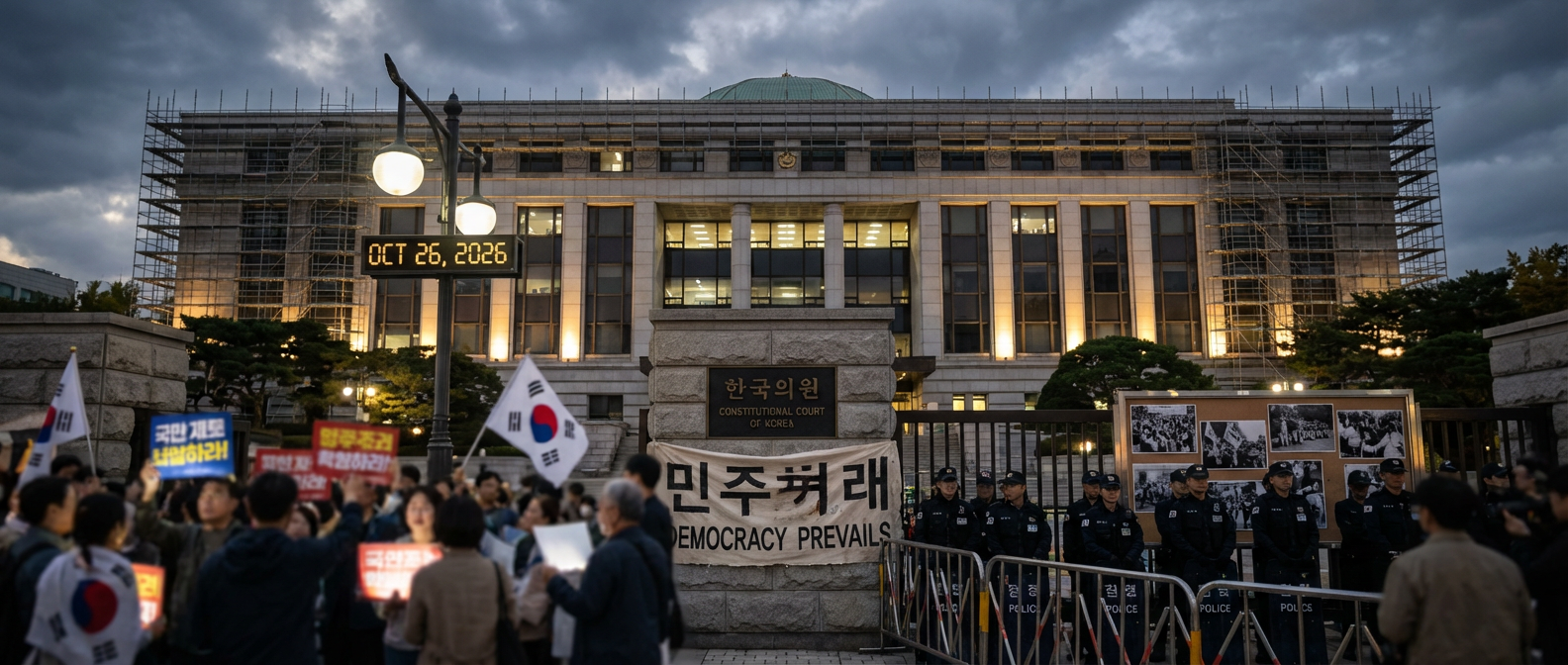
The seemingly simple question—whether a president can unilaterally declare martial law—hid deep complexities about executive power, legislative oversight, and judicial review in a mature democracy. Constitutional scholars had long debated the theoretical boundaries of presidential emergency powers, but the December 2024 incident forced these abstract discussions into reality. The Constitutional Court’s February 2026 ruling that Yoon’s actions violated established procedures was more than a legal judgment—it set precedent for how democratic institutions respond when constitutional boundaries are tested under pressure.
Understanding this crisis requires examining not just the immediate political drama, but the complex web of institutional responses that ultimately preserved democratic governance. The timeline from martial law declaration to electoral transition spans fourteen months of careful constitutional adjudication, economic uncertainty, and public debate about the limits of executive authority. Each phase reveals different aspects of how democratic resilience actually works in practice.

Parliamentary Response and Impeachment Mechanics
The National Assembly’s reaction to Yoon’s martial law declaration showed both the speed and deliberation that characterize effective legislative oversight. Within hours of the December 3 declaration, parliamentary leaders from across party lines condemned the action and began formal proceedings to reverse it. But the impeachment process required careful navigation of constitutional procedures that had been used only twice since democratization—against Roh Moo-hyun in 2004 and Park Geun-hye in 2016.
The 191-member coalition that supported impeachment in the National Assembly of Korea Official Statements represented significant cross-party consensus, but achieving this majority required extensive deliberation about constitutional interpretation and political precedent. Opposition leaders needed to balance legitimate constitutional concerns against potential accusations of partisan overreach, while members of Yoon’s own party faced difficult decisions about executive loyalty versus constitutional principles. The final vote count reflected genuine constitutional concerns rather than mere political opportunism.
The impeachment process itself revealed the careful balance built into Korean democratic institutions. Unlike purely political votes of no confidence, impeachment requires specific constitutional justifications that must be examined by the Constitutional Court. This two-stage process ensures that removal of an elected president requires both legislative consensus and judicial validation, preventing either branch from unilaterally overturning electoral results. The fourteen-month timeline from impeachment vote to final court decision allowed for thorough constitutional review while maintaining governmental continuity under acting leadership.
Constitutional Court Analysis and Precedent Setting
The Constitutional Court’s unanimous February 2026 ruling that Yoon’s martial law declaration violated established constitutional procedures was a landmark moment in Korean jurisprudence. The Constitutional Court of Korea Decision Archive now includes this decision as a definitive statement about the limits of presidential emergency powers, establishing clear precedent for future constitutional interpretation. The court’s analysis focused on procedural violations rather than political motivations, maintaining judicial neutrality while addressing fundamental questions about executive authority.
The 7-2 decision upholding parliamentary impeachment in March 2026 showed the court’s careful approach to constitutional interpretation. Rather than rubber-stamping legislative action, the court conducted independent analysis of whether Yoon’s actions met the constitutional threshold for removal from office. The two dissenting votes indicated genuine judicial deliberation rather than predetermined outcomes, while the majority opinion established clear guidelines for future cases involving presidential misconduct and emergency powers.
This judicial process created valuable precedent for democratic institutions facing similar challenges. The court’s emphasis on procedural violations rather than political disagreements provides a framework for distinguishing between legitimate constitutional concerns and partisan disputes. Future presidents now understand clearly that emergency powers require specific constitutional justifications and cannot be exercised unilaterally without legislative consultation. The decision strengthens democratic governance by clarifying the boundaries of executive authority while preserving necessary flexibility for genuine emergencies.
Economic Stability and Market Confidence
Financial markets initially responded to the constitutional crisis with predictable volatility, but the stabilization that followed revealed important lessons about economic resilience during political uncertainty. The Korean won’s recovery to 1,340 per USD and the KOSPI index’s 89% recovery of crisis-period losses showed that markets distinguish between temporary political disruption and fundamental institutional breakdown. International investors recognized that South Korea’s democratic institutions were functioning as designed, even under stress.
The economic response patterns differed from previous Korean political crises, reflecting both market maturity and institutional credibility. Unlike the 1997 financial crisis or various North Korean provocations, the 2024-2026 constitutional crisis didn’t trigger sustained capital flight or currency collapse. Foreign investors and domestic businesses recognized that constitutional processes were operating normally, even if the political situation remained uncertain. This market confidence reflected broader international recognition that Korean democratic institutions had proven their resilience.
Prime Minister Han Duck-soo’s role as acting president provided crucial continuity for economic policy during the transition period. As South Korea’s third acting president since democratization, Han’s leadership showed the institutional mechanisms designed to maintain governmental function during constitutional crises. His administration’s focus on economic stability and policy continuity reassured markets while avoiding major policy initiatives that might complicate the electoral transition scheduled for May 2026.
Public Opinion and Democratic Legitimacy
Perhaps most remarkably, Gallup Korea polling showed public approval for democratic institutions reaching 78% in March 2026—the highest level since the 2016 Park Geun-hye impeachment crisis. This result suggests that Korean citizens distinguished between disappointment with specific political leaders and confidence in democratic processes themselves. Rather than undermining faith in democracy, the constitutional crisis actually demonstrated the effectiveness of institutional safeguards designed to prevent authoritarian backsliding.
The polling data reveals sophisticated public understanding of constitutional processes and democratic accountability. Citizens recognized that impeachment and judicial review represented democracy working as intended, rather than evidence of systemic failure. This public response contrasts sharply with democratic crises in other countries where constitutional conflicts have undermined broader faith in democratic governance. Korean democracy appears to have emerged stronger from this stress test, with enhanced public confidence in institutional resilience.
The May 2026 elections will ultimately determine whether this institutional resilience translates into stable democratic governance going forward. The constitutional crisis has established important precedents about executive limits and democratic accountability, but the real test lies in how future leaders respect these boundaries and how citizens continue to support democratic institutions even when they produce uncomfortable political outcomes. The evidence suggests that Korean democracy has matured considerably since 1987, developing the institutional depth and public support necessary to weather serious constitutional challenges.
What questions do you think this crisis raises about the balance between executive emergency powers and democratic oversight in other established democracies? The Korean precedent offers valuable insights for constitutional scholars and democratic practitioners worldwide.
